5 Things People With Hypermobility Need to Know About Their Body
Insights from a hypermobile physiotherapist
On many initial phone calls, I often spend time explaining what hypermobility is and how it can affect the body. People often tell me they finally feel understood because what I’m describing matches what they’ve been experiencing, without me knowing anything about their body.
Hypermobility can look different from person to person. Some people are flexible and have little or no pain. Others experience joint instability, recurring injuries, pain in several areas, or difficulty feeling at ease in their body, plus a cocktail of medical comorbities.
After every call, I wish more people with hypermobility could understand their body and feel reassured that there are physiotherapists who understand what they’re going through.
Here are five things I wish more people with hypermobility knew about their body.
1. Hypermobility is about more than being flexible.
People sometimes think, “I used to dance, so I’m flexible,” or assume that being told their body is tight means they can’t be hypermobile. But flexibility on its own doesn’t tell us how your body is managing movement. There is so much more to the story.
Muscles, tendons, and ligaments help support a joint. When the tissue has less integrity, it can support the joint less. That means the body may need more strength and stability around the joint to control its movement.
As a starting place, the Beighton scale can be useful as a general screen for hypermobility. It looks at movements such as hyperextending the elbows or knees and bending the thumb or wrist. The Beighton scale is scored out of 9-points and a positive score is 6/9 for children pre-puberty, 5/9 for most adults and 4/9 for adults over 50 years of age.
That being said, the Beighton scale doesn’t consider the whole picture. It doesn’t consider how the body moves, what the “flexibility” is controlled, or the extent of your injury history and how this may be affecting you. It also doesn’t consider if you have any medical co-morbidities, if you’re experiencing any ongoing symptoms and how you’re able to manage in everyday life.
The Ehlers-Danlos Society also notes that the Beighton score does not assess every joint, so it may not tell the whole story by itself. What is HSD?
While the Ehlers-Danlos Society is working on an improved diagnostic criteria, the main message to consider is that being diagnosed with hypermobility takes understanding of the whole body and multiple systems altogether. It’s not enough to say you’re hypermobile if you can do the splits or if you have a positive score on the Beighton scale. A health professional who regularly sees hypermobile clients should be able to provide this insight to you.
2. You need to stretch less and start strengthening more.
If you believe you’re hypermobile but you’ve been told that you’re super tight, you may be wondering, “Am I in fact hypermobile, after all?”. The answer can be, yes! Your body can feel tight AND still be hypermobile.
In fact, this can be a common presentation amongst hypermobile individuals. When there isn’t enough stability across a joint, the body may brace to try to control it. That can create extra muscle tension even at rest. The body may also hyperextend or lock out joints, or find other workarounds instead of using the muscles efficiently.
In general, stretching or muscle release may ease the symptoms and/or tightness for a period of time. But if the body still needs more strength and support around the joint, stretching and muscle release on their own doesn’t address the underlying deficit. That can be why a tight or painful area improves for a while and then can come back. Instead, what the body really needs is to build strength in the muscles, which create stability at joints.
That being said, there can be a place for targeted muscle release when a compensatory movement pattern is very committed. Releasing the area can help get rid of that pattern enough to train a better movement. But release on its own isn’t what hypermobile individuals typically need. They need specific physiotherapy exercises to strengthen the area and help the body move with more control.
3. New pain isn’t necessarily a new issue. It may be a compensation for something else that isn’t moving well from before.
After an ankle sprain, someone may not put as much weight through that foot. They may shift their weight to the other side, or the injured leg may not weight bear as much. The body may start hyperextending joints and using muscles to lock them out.
That can bring on more tightness around the low back as it braces. If someone offloads or leans to one side, it can even affect how their upper body moves.
These same mechanisms can happen in people who are not hypermobile. But because a hypermobile person’s body is more mobile, this can happen more easily and result in more symptoms. So new pain may not be a separate new issue. It may be a compensation for something else that isn’t moving well.
4. If exercise has felt hard to get into, your body may need more feedback.
Do you ever feel like you’re a bit more clumsy than others? Or have a hard time sensing where your limbs are in space or doing exercises properly?
Your body uses different kinds of sensory information when you move. Proprioception is your sense of where your body is and how it is moving. For example, it helps you sense where your arms and legs are without needing to look at them.
Interoception is your awareness of what is happening inside your body. During exercise, that can include noticing your breathing, heartbeat, or how tired you feel. It helps you recognize how your body is responding to the effort.
When either sense is less clear (which is often the case amongst hypermobile individuals), exercise can feel harder to figure out. You may understand what an exercise is asking you to do, but find the movement awkward or have trouble sensing whether your body is in the position you want. You may also find it difficult to tell how your body is responding as you exercise. Extra feedback, cueing, and guided practice can help you learn the movement and understand your body’s response.
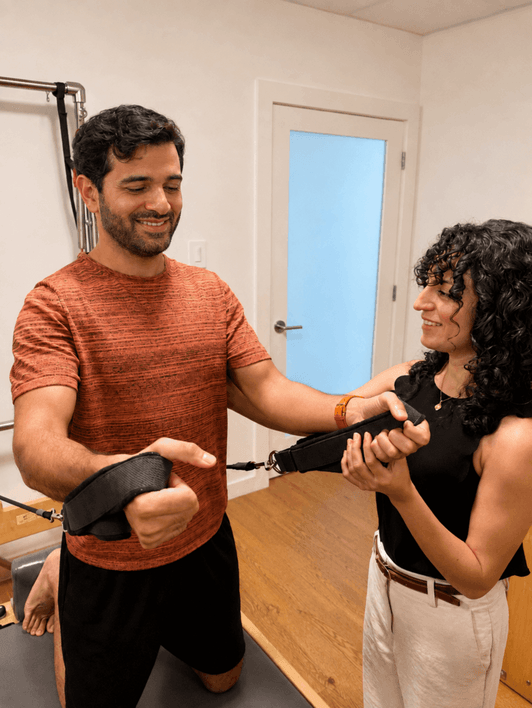
At Cadence, we work on alignment and use specific exercises to help you build strength and practise movement. We focus on exercises that provide you more feedback and also guide you with verbal and hands-on cues. Exercises where your body is attached to something can give you more information about where you are and how you’re moving.
This is one reason Clinical Pilates suits many people with hypermobility. The straps, jumpboard, and other apparatus give you something to feel against as you move, helping you practise moving the way you intend.
5. The sore area may not be where the issue is.
Here is an example of how one problem can spread. After an ankle sprain, that foot takes less weight, so you offload onto the other side. When a foot is more stiff it’s more rigid to accepting load, and therefore the loaded joints tend to hyperextend and lock out, instead of using the muscles to support your joint. That can tighten the low back as it braces, and leaning to one side can affect the upper body too. The same thing can happen to anyone, but with more mobile tissue it can happens more easily and tends to cause more symptoms.
In this case, a cascade of potential symptoms up the chain (the upper body, opposite leg, the lower back) are all trying to compensate for a leg that isn’t weight bearing well (which is the root-cause issue).
That is why we treat the whole body instead of one painful spot. In your assessment we take your injury history, work out which area was affected earliest and whether there was a clear mechanism of injury. Then we do tests to understand how one area might influence another. If improving one area changes your other complaints, we know it is a driver and not just a place where your body compensates. Most people leave that first session with a better understanding of which areas to release, which to leave alone and how to keep an eye on their body.
Looking for a physiotherapist in Vancouver who understands Hypermobility and Ehlers Danlos Syndrome (EDS)?
At Cadence Physiotherapy & Rehab, our physiotherapists take a whole-body approach and understand hypermobility. We look at how your body is moving, what may be driving your symptoms, and where strength, stability, alignment, or movement feedback may help. Physiotherapy and Clinical Pilates sessions are both tailored to your needs and goals.
Book a physiotherapy assessment today and take the first step to understanding your body. No referral is needed and direct billing is available.