
Clinical Pilates in Vancouver: How It Helps You Move Better and Get Stronger
If you want to get active, get stronger, or continue doing Pilates with a little more help to move better and deal with an injury, Clinical Pilates may be a good fit.
At Cadence Physiotherapy & Rehab, Clinical Pilates is different from regular Pilates because your physiotherapist first assesses the area of the body that needs to be addressed, how it is moving, and what limitations there might be. This helps us understand which exercises should be used to train your body and target the muscles that need to be strengthened.
What makes Clinical Pilates different from regular Pilates?
During the assessment, we look for things like differences in strength, imbalances in muscle activation, or differences in movement patterns.
When muscles are weak, it can change the movement pattern because the body tends to rely on stronger muscles. By identifying this, we can determine which exercises need to be used to target and isolate some of the weaker muscles that need to be strengthened.
Helping the body relearn better movement patterns will often involve strengthening these weaker muscles.
What does a Clinical Pilates session look like?
A session typically starts with a physiotherapy assessment to determine what needs to be addressed. From there, we go through specific Clinical Pilates exercises on the apparatus.
Depending on what your body needs, this may include the reformer, Tower Bar, Pilates chair or springboard. Through the exercises, we target the muscles that need to be strengthened. We also reassess during the session and check how your body is responding in real time.
Hands-on feedback helps guide your movement
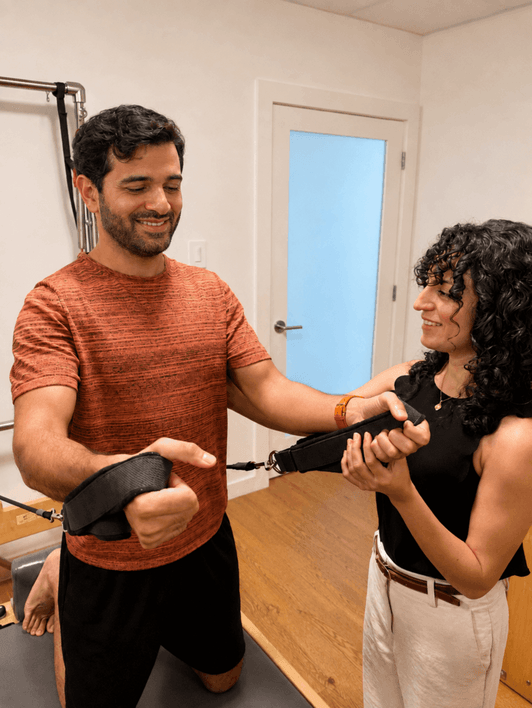
At Cadence, we often use hands-on feedback to guide your body in space and show it how to move. This may also involve some muscle release. If a muscle is restricting motion, we can release it so your body can move better. Then we can work on optimizing the movement pattern and strengthening the area we’re targeting.
The individualized and personalized approach is something clients value. These are not just exercise sessions. We have a specific goal we’re trying to target, and we check how your body responds as we go through different exercises.
You’ll receive verbal cueing, hands-on cueing and guidance so your body can learn the position it needs to be in to move better. Improving how you feel your body in space, also known as proprioception, can help you move through daily life with more awareness.
“I was looking for a different approach to my body’s injuries and limitations and wanted to incorporate clinical Pilates into my physio routine. The approach at Cadence, and my physio’s patience and knowledge have been key to my journey in healing from past injuries and strengthening my body for the future.”
“Combining Dry needling (IMS) and manual therapy for muscle release, along with Clinical Pilates and targeted home exercise programs has addressed both the symptoms and root causes to my issues.”
Common reasons people come to Clinical Pilates
Clinical Pilates may be included in a physiotherapy plan for people who want support with:
- Low back pain, including recurring back pain or difficulty moving comfortably.
- Neck and upper back pain, including movement concerns that may come with long hours at a desk.
- Shoulder pain or limited shoulder movement.
- Hip or knee pain, osteoarthritis, differences in strength and muscle activation that affect movement.
- Sports and running injuries, including calf strains, glute activation issues, building strength and control while working toward a return to activity.
- Injuries after a car accident, when someone is working to strengthen their body and return to daily activities.
- Hypermobility or Ehlers-Danlos syndrome (EDS), when someone wants individualized guidance with strength, muscle activation, movement patterns or proprioception. Exercises are adapted to the person and how their body responds.
- Muscle weakness, muscle imbalances or difficulty activating specific muscles.
- Postural and movement concerns for desk workers who want to work on how they sit, stand and move.
- Maintaining strength and mobility with age, with exercises selected for the person’s needs and goals.
- Getting started with exercise, or returning to Pilates when pain, injury or uncertainty about movement makes it difficult to know what to do.
A physiotherapy assessment helps determine what needs to be addressed and whether Clinical Pilates is a good fit for your goals. Your physiotherapist can check how your body responds and adjust the exercises as you go.
Clinical Pilates at Cadence Physiotherapy & Rehab
At Cadence, we use a physiotherapy assessment and targeted Clinical Pilates exercises to identify what your body needs and help you work on it. We’re here to empower you to move better and get stronger for the long term.
If you’re ready to get active, build strength, return to Pilates or work around an injury, book an initial assessment with physiotherapist Medis Shojaei. She is our experienced Clinical Pilates physiotherapist and loves working with clients to help improve their strength. Medis will learn about your goals, assess how your body moves and guide you through a personalized Clinical Pilates plan.
Our Vancouver clinic is near Broadway and Cambie. Book a Clinical Pilates assessment with Medis.
Frequently asked questions about Clinical Pilates
What is Clinical Pilates, and how is it different from regular Pilates?
At Cadence, Clinical Pilates starts with a physiotherapy assessment. Your physiotherapist looks at how your body moves, what limitations there might be, and which muscles may need to be strengthened. From there, we choose exercises for your body and your goals, using Pilates apparatus such as the reformer, Tower Bar, Pilates chair or springboard. It’s an individualized physiotherapy session, rather than a general class routine.
Can Clinical Pilates be part of my physiotherapy plan for pain or an injury?
It may be, depending on what your physiotherapist finds during the assessment. Clinical Pilates exercises can be selected to work on specific areas of strength, muscle activation or movement patterns as part of a physiotherapy plan. People may ask about it when dealing with back, neck, shoulder, hip or knee pain, recovering from an injury or working toward a return to activity.
If you have hypermobility or Ehlers-Danlos syndrome (EDS), your physiotherapist can assess your movement and consider whether tailored exercises are appropriate for your needs. Exercise guidance for EDS should be adapted to the individual’s abilities and limitations. The Ehlers-Danlos Society shares more information about physiotherapy for EDS and hypermobility.
Are Clinical Pilates sessions covered by my extended health benefits?
If your extended health plan covers physiotherapy, you can submit your Clinical Pilates session under your physiotherapy benefits. Sessions at Cadence are led by registered physiotherapists and billed as physiotherapy. Your plan determines the reimbursement amount and any limits, so check your coverage details with your provider.
What happens during a Clinical Pilates session?
We start with a physiotherapy assessment to determine what needs to be addressed. Then your physiotherapist guides you through specific exercises on Pilates apparatus. You’ll receive verbal and hands-on cueing, and we check how your body responds as you go. The exercises can be adjusted during the session based on that response.
Do I need Pilates experience to start?
No previous Pilates experience is required. Whether you’re new to Pilates or already have a regular practice, your physiotherapist will guide you through exercises selected for your body and goals.